LGBTQ+ History Month
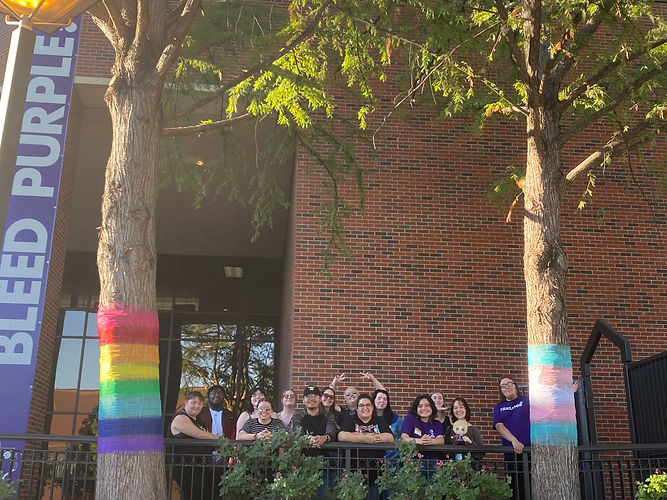
In 2015 the Tarleton Gay/Straight Alliance was looking for ways to raise awareness about LGBTQ history month. In partnership with the Office of Diversity and Inclusion, the GSA obtained permission to wrap a series of trees near the Thompson Student Center. This temporary art project allows the GSA to honor the memory of those who fought for equality and recognition on college campuses, in legal battles, and who continue to do so for their identities today.
This year the wrapped trees represent the original 8 color flag, the transgender, flag, the new progressive flag, and the most common 6 color flag. See details and examples of each flag on this page.
LGBTQ+ History
The history of the LGBTQ+ population is diverse and spans the entirety of human history. Whenever humans existed, some of us were queer. We have always been here.
The OG Pride Flag
It was created in 1977 by Gilbert Baker, an artist, activist, and openly gay military veteran. Tasked by Harvey Milk, a historic figure in the fight for LGBTQ rights, to create a flag for the queer community, Baker created a rainbow flag with eight different colors.
Inspired by the classic song "Over the Rainbow" from the 1939 film The Wizard from Oz, Baker created a rainbow flag to represent LGBTQ folks. Each color in the flag also had a specific meaning.
Hot Pink symbolizes sex
Red equals life
Orange symbolizes healing
Yellow stands for sunlight
Green represents nature
Turquoise equals magic & art
Indigo stands for serenity
Violet represents the spirit of LGBTQ people
Modern Pride Flag
The 6-Color Pride Flag is one of the most well-known and used LGBT flags throughout history. This flag includes the colors red, orange, yellow, green, indigo, and violet on it.
Hot pink wasn´t included in the fabrication of these flags, because the fabric was hard to find. As the demand for the flag started to rise after the assassination of gay San Francisco City Supervisor Harvey Milk on November 27, 1978.
In 1979, the flag was modified again. Aiming to decorate the streetlamps along the parade route with hundreds of rainbow banners, Gilbert Baker decided to split the motif in two with an even number of stripes flanking each lamp pole. To achieve this effect, he dropped the turquoise stripe that had been used in the seven-stripe flag. The result was the six-stripe version of the flag that would become the standard for future production.
The Trans Flag
The Transgender Flag was first created in 1999 by Monica Helms, a transgender woman. Light blue and pink are featured because they’re the traditional colors associated with baby boys and girls, respectively. The white stands for those who are intersex, transitioning or those who don´t feel identified with any gender.
Transgender people have a gender identity or gender expression that differs from the sex that they were assigned at birth. According to Amnesty International, 1.5 million transgender people live in the European Union, making up 0.3% of the population. And more than 1.4 million trans adults living in the U.S., which is about 0,5% of the population.
Violence against the queer community affects trans people of color the most. Therefore, the Transgender Flag is so important! The trans community needs representation and resources to be visible without fear.
The Progressive Flag
Given the evolving nature of the LGBTQ+ community and society at large, the Progress Pride Flag integrates many of these flags into one. Thankfully, it has been redesigned to place a greater emphasis on “inclusion and progression.” Our community is such a huge umbrella of different kind of people and that is what makes us so special, that is what makes us so unique and that is what makes us so powerful.
The modern pride flag now includes stripes to represent the experiences of people of color, as well as stripes to represent people who identify as transgender, gender nonconforming (GNC) and/or undefined.
Daniel Quasar’s flag includes the colors of the trans flag, as well as black and brown stripes harkening back to 2017 Philadelphia Pride Flag, which sought to further represent the queer and trans identities of black and brown people. Those two stripes also represent those living with HIV/AIDS, people who have passed from the virus and the overall stigma surrounding HIV/AIDS that remains today.

Partnering
If you would like to partner with the GSA (and we would love to partner with you) please contact us!
